Federal Judge rules Happy Birthday to You no longer copyrighted
Dulcimer Resources:TABS/Books/websites/DVDs
That's the next phase of litigation. We will see what the judge decides.
Ken
"The dulcimer sings a sweet song."
That's the next phase of litigation. We will see what the judge decides.
Ken
"The dulcimer sings a sweet song."
A victory for people and a strike against corporate greed!
I wonder if Warner will be obligated to pay back all those royalties they demanded over the years.
Thanks Ken! And thanks for your advice!
The strings that I use on the Prichard dulcimer and others are , .013 melody and middle and .020 on the bass . These srtings are hand made plain steel piano wire. That's what I sent to Ken also.
Really good job there, Patty. Looks professional. I'm sure your neighbor will enjoy using it.
Ken
"The dulcimer sings a sweet song."
Very nice job Patty, Looks like it will be a fine bow.
I play unwound bass strings. I find they help me get the 'high silvery' old time sound I prefer, rather than the more mellow modern sound. Most of my dulcimers have a 27" VSL and I find that a .018 plain steel string works pretty good for the range of tunings that I use. I you like that mellow 'guitar-like' sound then use a wound bass string, IMHO.
D2-D3-A3-A4 equidistant -- Sure. Why not. I've not seen/heard anyone do it, but don't let that stop you if you're looking for baritone/bass sound. You'll probably want a new nut and bridge set up for 4 strings rather than filing a bunch of notches on the ones you'll have.
re - vibration on the back side of the fret. I'd say that you're not fretting quite hard enough. It could be the low tuning with the strings you have, but it sounds more like not fretting firmly enough. The sort of 'standard' action height is what we call "nickel & dime". That is strings just touching a dime placed next to the first fret, and also just touching a nickel set on top of the 7th fret. You can lower the action more if it suits you, by sanding tiny amounts off of the bottom of the net and bridge.
The string gauge calculator many of us use is at http://www.strothers.com/string_choice.htm It is noticeably light , however, and you can generally go 1-2 gauges heavier.
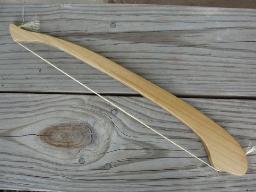
Just wanted to let you all know I finally finished making a bow (psaltery bow) for my neighbor's violin uke. Here is a picture:
The strings gauges used on the Sweet Woods instruments are for playing in DAdd. There is no reason they can't be used for C - G - C, but will be at lower tension when tuned to pitch. The "ideal" string for the "C" bass would be a 0.023. Wound strings have an inner core that is a smaller gauge. If you tried to tune up a 0.023 to the C bellow middle C you might break it. In the usual DAd tuning the Ds are an octave apart. The high d being a note above middle C and the low D below middle C. Do you want to go an octave below that?
Ken
"The dulcimer sings a sweet song."
Don't forget the alternate lyrics-- my favorite lyrics at one time. I assume these were never copyright protected. :)
Happy birthday to you
You live in the zoo
You look like a monkey
And you act like one, too!
Notice how Happy Birthday doesn't even have a "B part"? ...'cause the candles are melting and so is the ice cream, so hurry it up! 
Hi Rob, I have been doing this song since the 60's, and now do it on the dulcimer. Had their original LP but don't know what happened to it. For those of you who may not know, Richard died in a motorcycle accident just after his book came out. Mimi (Joan Baez's younger sister) died of cancer around 2003.
I play it bagpipe...
0 0 1 0 3 2
0 0 1 0 4 3
0 0 7 5 3 2 1
6 6 5 3 4 3
Could someone email me a tab of that for the dulcimer?
Here's a link to a video you may know about already; I reckon it's the only one of Richard and Mimi playing it. The video and the sound aren't in synch, but you can get the idea from it. I think he's playing in DAd based on his tuning at the beginning and the position of the chopstick he's using as a noter. That being said, I think it sounds good in DAA and John P's notes should be able to get you started.
Neal Hellman's made his "Richard Farina Dulcimer Book" available as a free pdf, but that song's not in it, perhaps because Mimi and Joan's sister Pauline is credited with authorship. Some say she just gave him the title, but he wanted her to have something material from the idea.
http://gourdmusic.blogspot.com/2010/05/liberating-richard.html
Can we do that as a monthly challenge? lol
Well, it's about time! The copyright was no longer benefiting the family, just some corporation.
Well, how about that! Happy Birthday everyone!!
Ken
"The dulcimer sings a sweet song."
http://consumerist.com/2015/09/23/judge-says-happy-birthday-song-no-longer-covered-by-copyright
http://www.nbcnews.com/pop-culture/music/music-company-does-not-own-happy-birthday-song-copyright-judge-n432001
several other sites have posted the information also
Hi joos.
This Richard Farina recording on youtube is done in noter/drone style, and it's not too difficult to pick out the notes by ear.
Pack Up Your Sorrows
What's a bit more difficult is that the tune has a slightly broken strum that may take a bit more work.
If you would like to try picking it out by ear - here's a nudge to get you started.
5 7 5 4 3 8 8 8 10 8 7 6 / 5 5 5 7 7 5 4 ...
Tuning is Ionian DAA (or equiv).
If you would like to use DAd then subtract 3 from the fret order
My ten years old son just hides my bones, but I have a rather large collection.
My upstairs office is directly above Brian's downstairs office. For bones practice, I'm supposed to go in the other upstairs room to cut down on the racket...oops I mean rattle. And 10pm is the bones curfew, which I think is quite reasonable. lolol
My family doesn't mind my practicing, as long as it is outdoors. 
Hey I'm just happy to have other bones nuts to talk to!
Your's, and Bob's, bones (spoons) playing videos were very inspiring.
Found out the nice lady who runs our weekly Dulcimer class is learning to play the bones too. She had a set of bones, and a pair of wood shims, with her last week(Just plain wood shims you can find a your local home improvement store). She had sanded the edges smooth. They were a little wide for my small hands, but they could easily be cut to be narrower. They are a creative, cheap, alternative to buying bones if you want to try them, but don't want to shell out the dough.
Bringing my bones next time, and my Tim Twiss CD for a little extra-curricular activity. Should be fun!
I created my tab in Excel, by altering the height of each line, and placing borders on four lines, to give me three spaces. From there, it was just a matter of copying that format, and pasting it down the page. It took a little tweaking to get the height correct, but worked for me.
When I play with guitar players, I usually try a couple of things: Key of D (in either DAd or DAA tuning) and Key of G using DGd tuning. D and G are common and comfortable keys to play on guitar. If your guitarist wants to play in C it's easy to capo the guitar up one step (which puts it in D) and you play the dulcimer in D (again using either DAd or DAA tuning).
If I am doing a mix of chord style and noter-drone in the same session, I like to use DAd for chord style and DGd for noter drone because you can quickly re-tune that middle string from A down to G and it's easy to hear the perfect 4th between the D and G strings. It sounds like the first two notes of Here Comes the Bride.
Hmm...wondering if you could tune your bass and melody strings down a bit to C (middle string up to C), and then use a pencil or dowel to make barre chords across all your strings, and just play the melody if the songs are following a familiar structure, or else find your three I IV V main barre chords that match the tune's key. Might not take long to figure out the key, and by knowing your zero fret is C, you can find the tonic barr chord right away and you're in business. This could work fine especially since you have the 1.5 and 6.5 frets. It'd be less to think about, no chord fingerings to keep remembering and switching, and might work well for that unusual situation, surrounded by key-changing guitars all night.
Another option is to tune to CGc and do the same, making barre chords after you locate the tonic location for each tune they play. Doing from the home base of C would be easier to calculate on the fly than starting in D on the open strings.
You can play the I IV and V chords for the keys of D, A, and G in DAA tuning. The "extra fret" is helpful, enabling you to play an E chord in the midrange of the fretboard. So if you are tuned DAA, The I IV and V chords are D, G, and A, respectively for the key of D. If the other jammers switch to G, the I IV and V chords are G, C, and D, respectively. Make the C chord on frets 6,4, and 6. When they switch to A, the I IV and V chords are A, D, and E, respectively. Make the E chord on frets 5,4, and 6+, from bass to treble (far to near). Fiddle and banjo players love the "sharp" keys, so this knowledge will carry you far. If you find your jamming mates want more keys than that, an extra instrument is advisable. 
OTSFM sometimes has a dulcimer or two for sale. Hogeye usually has a few dulcimers. Not much selection at either. Sadly, no place that I've found in Chi-town has a decent selection. Some regional builder (hey, Folkcraft!) should bang on the door at OTSFM and throw us poor starving Chicago MD players some dulcimers!
The Old Town School of Folk Music is a must-visit: https://www.oldtownschool.org/musicstore/
Check the schedule for concerts and workshops. When will you be in Chicago? There's a workshop on Appalachian Singing on Sept. 28. The ongoing MD classes meet on Thursday nights and the dulcimer ensemble meets on Mondays -- maybe you can sweet-talk your way in.
If you get up north, visit Hogeye Music in Evanston: http://www.hogeyemusic.com/hogeyemusic.com/Welcome.html
ETA: heeheehee, I am not fast enough ;-) Did we mention you MUST visit the Old Town School?
Joe, I suggest that you stop by the Old Town School of Folk Music. If they don't have books you want, they can probably tell you where to find them in the Chicago area. Here is the website: https://www.oldtownschool.org . Hope this helps.
Ken
"The dulcimer sings a sweet song."